Thanks for listening to the beat.
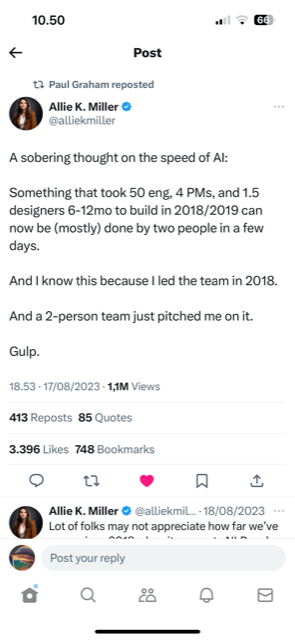
X is flooded with many encounters of laments or elations regarding AI. One particularly interesting one I came across a few days ago was from Allie K. Miller, who was the Global Head of Machine Learning Business Development for Startups and Venture Capital at Amazon (AWS), advising the top machine learning researchers and founders in the world.
Updated Oct 2026. This piece first ran in August 2023. The post and the argument are unchanged. New sections add three years of research, with sources at the end.
This piece really struck me as an epitome of how AI is assisting human creativity, ingenuity, and productivity, that AI has a place to enhance but at the same time, threaten those who will not or are too late to adopt the new tool.
What the post was really saying
The numbers in the post are what make it land: roughly 55 people working for six to twelve months in 2018, compared with two people working for a few days in 2023. Even allowing for the “(mostly),” that is a change in scale, not a small productivity gain.
Since 2023, big employers have started planning around exactly that idea. Microsoft’s 2025 Work Trend Index, based on a survey of 31,000 workers in 31 countries, found that 82% of leaders say this is a pivotal year to rethink key parts of strategy and operations. And 81% expect AI agents to be moderately or extensively integrated into their company’s AI strategy in the next 12 to 18 months.1
Adoption is real but uneven. In the same report, 24% of leaders said their companies had already deployed AI organization-wide, while 12% were still in pilot mode.1 Most companies are somewhere in between, with pockets of “two people in a few days” sitting next to teams that work the old way.
The pressure behind it is easy to recognize. In the same survey, 80% of the global workforce, both employees and leaders, said they lack enough time or energy to do their work.1 A tool that turns months into days is not just impressive. For many teams it is a way to keep up.
What the research says about the superpower
Three well-known studies give the post some hard numbers.
- Writing. In an MIT experiment, 453 college-educated professionals did writing tasks from their own jobs. With ChatGPT, they finished 40 percent faster, and the quality of their work rose by 18 percent.2
- Customer support. A study of 5,179 customer support agents found that an AI assistant increased the number of issues resolved per hour by 14% on average, and by 34% for novice and low-skilled workers.3
- Consulting. In a Harvard Business School and Boston Consulting Group experiment with 758 consultants, those using AI completed 12.2% more tasks and finished them 25.1% more quickly, with better quality.4
Notice who gains the most in the support study: the newest and least experienced people. AI spreads expertise around. Microsoft’s CEO Satya Nadella put it this way in 2024: “AI is democratizing expertise across the workforce.”5
The jagged edge of the superpower
The same consulting study comes with a warning. For a task deliberately chosen to sit outside what AI does well, consultants using AI were 19% less likely to reach the correct answer than those working without it.4 The researchers call this the “jagged technological frontier”: AI helps a lot with some tasks and hurts with others that look just as hard.
Superhuman, then, does not mean flawless. The real skill is knowing which side of the frontier a task is on. Writing a first draft, summarizing a long report, or exploring options sits comfortably inside. Judging a messy situation with missing facts often does not.
That is why the best results in these studies come from people who stay in charge. They hand the AI the parts it is good at and check the rest, instead of letting the tool decide everything.
Who it threatens
The second half of the original point, that AI threatens “those who will not or are too late to adopt,” has become a common view. Harvard Business School professor Karim Lakhani made it the headline of a 2023 interview with Harvard Business Review: “AI Won’t Replace Humans — But Humans With AI Will Replace Humans Without AI.”6
Many workers are not waiting for permission. Microsoft and LinkedIn’s 2024 survey found that 75% of knowledge workers already use AI at work, and 78% of AI users bring their own tools. Only 39% of users had received AI training from their company.5 The people are adopting. The organizations often are not keeping up.
Fears about jobs are growing, but so far they run ahead of reality. In McKinsey’s 2026 survey, 39% of respondents expect AI to reduce their organization’s total head count in the coming year. Yet only 14% said AI contributed to a decline in workforce size over the past year, less than half the share who had expected one a year earlier. And just 13% said AI makes them anxious about their own career prospects.7
The bigger gap may be between people and their companies. Eight in ten McKinsey respondents say AI has improved their own productivity, yet only 37 percent report that AI has contributed to their organization’s EBIT, about the same as a year earlier. The few “AI high performers,” about 6 percent of respondents, are set apart by changing how work gets done: nearly three-quarters of them have fundamentally redesigned workflows because of AI, compared with one-quarter of others.7 Superhuman individuals do not automatically add up to a superhuman company.
How to use the superpower well
The lesson from Allie K. Miller’s post still holds: the gap between people who use AI well and people who don’t is getting wider. Closing it doesn’t take a big program. It takes a few habits that anyone can start this month.
Pick tasks inside the frontier first: drafts, summaries, research outlines, and first-pass analysis. Give your team approved tools and some training, so they don’t have to bring their own. Keep a person responsible for the final answer, especially when the task involves judgment. And measure the result in time saved and quality gained, not in how often the tool is opened.
Coming soon: Your first week with an AI assistant at work
Sources
-
2025: The year the Frontier Firm is born (Work Trend Index), Microsoft WorkLab, Apr 2025 ↩ ↩2 ↩3
-
Study finds ChatGPT boosts worker productivity for some writing tasks, MIT News, Jul 14, 2023 ↩
-
Generative AI at work (Working Paper 31161), National Bureau of Economic Research (Brynjolfsson, Li and Raymond), Apr 2023 ↩
-
Navigating the jagged technological frontier: Field experimental evidence of the effects of AI on knowledge worker productivity and quality, Harvard Business School (Dell’Acqua et al.), Sep 2023 ↩ ↩2
-
Microsoft and LinkedIn release the 2024 Work Trend Index on the state of AI at work, Microsoft, May 8, 2024 ↩ ↩2
-
AI won’t replace humans, but humans with AI will replace humans without AI, Harvard Business Review, Aug 4, 2023 ↩
-
The state of AI in 2026: On the road to ROI, McKinsey & Company, Aug 25, 2026 ↩ ↩2
Frequently asked questions
How much does AI speed up writing work?
By about 40 percent in one study. In an MIT experiment, 453 professionals using ChatGPT on writing tasks from their own jobs finished 40 percent faster, and the quality of their work rose by 18 percent.
Can AI make people worse at their work?
Yes, on the wrong tasks. AI helps a lot with some tasks and hurts with others that look just as hard. On a task chosen to sit outside what AI does well, consultants using AI were 19% less likely to reach the correct answer.
Will AI replace people at work?
The bigger risk is being outpaced by people who use it. As Harvard Business School professor Karim Lakhani put it: “AI Won’t Replace Humans — But Humans With AI Will Replace Humans Without AI.”
Do individual AI gains add up for the company?
Not automatically. Eight in ten McKinsey respondents say AI has improved their own productivity, yet only 37 percent report that it has contributed to their organization’s EBIT. The few high performers stand out because they redesigned workflows.
First published on nicolefung.pro on August 28, 2023. Updated Oct 2026 with new data and sources; the original text is kept, lightly edited for US spelling and obvious typos.